IDIA Lab: Selected Works
- Emerging Technology
 ENGAGING TECHNOLOGY
A HISTORY AND FUTURE OF INTERMEDIA
BALL STATE UNIVERSITY MUSEUM OF ART
NOVEMBER 17, 2006 THROUGH MARCH 11, 2007
Curator: John Fillwalk
Engaging Technology traces a range of both pioneering and contemporary works exploring the intersections of electronic media and various modes of art-making. The artists selected for this exhibition - Richard Bloes, Hans Breder, Adam Brown, Dick Higgins, Gary Hill, Jenny Holzer, Golan Levin, Nam June Paik, and Alan Rath have contributed works encompassing a broad array of forms including video, sculpture, sound, music, electronic installation and interactive environments. - Hans Breder Foundation
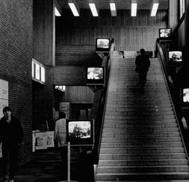
HANS BREDER FOUNDATION
The mission of the Hans Breder Foundation is to establish
and international center for the study and dissemination of intermedia art. The archive will be housed in the Ostwall-Museum in the Dortmund Center for Art and Creativity and sponsored by the TU Dortmund University in Germany. The core of the project is the archive of Hans Breder who created the first academic graduate program in Intermedia at the University of Iowa in 1968 and directed it until 2000. It is the intention of the Hans Breder Foundation to create both a physical and intellectual environment where students, researchers, artists, critics and the public can come together around a range of experimental perspective, practice and programming.
President: John Fillwalk - Flickr Gettr
 VIRTUAL WORLD/SOCIAL MEDIA MASHUP: Flickr Gettr v4
IDIA's Flickr Gettr connects the social image repository of Flickr to Virtual Worlds and mobile devices. through an interactive 3D and sonic experience - immersing the viewer in a dimensional cloud of user searched imagery. Artist: John Fillwalk and Jesse Allison. - Final Wisdom I at SIGGRAPH 2010
 FINAL WISDOM I
Final Wisdom I is an interactive installation engaging viewers in a sensory exploration of temporal and spatialized poetry. Participants manipulate imagery, sound and language through their gesture, touch and proximity. The work is engaged through a framework of cameras and sensors that react to heat, position, and capacitance – presenting a shifting environment of reactive media and haptics. Final Wisdom I is the work of artists Hans Breder and John Fillwalk, poetry by critic Donald Kuspit, music by composers Carlos Cuellar Brown and Jesse Allison. - IDIA at Philips HighTech Campus during Dutch Design Week
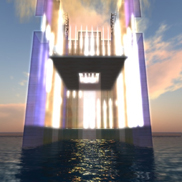
TRAVERSAL FOR EINDHOVEN
during Dutch Design Week
Collaboration with IDIA Lab and MAD Emergent Art Center
IDIA Lab: John Fillwalk and Jesse Allison
MAD Emergent Art Center: Rien Daamen and Réné Paré
Physical location: Philips HighTech Campus and NatLab in Eindhoven, Nederlands
http://www.hightechcampus.nl/
'Traversal for Eindhoven' is a live performance/hybrid reality installation that bridges the physical and virtual worlds. It connects Philips NatLab in Eindhoven to a virtual environment as part of the 2009 Dutch Design Week. Avatars will be able to perform a physical synthesizer in the Philips NatLab via an interactive online virtual instrument built by IDIA - located near a 3D model of the Eindoven High Tech Campus. The sound of the live synthesizer will be streamed back into the virtual world, so the virtual and physical participants can hear their interactions with the instrument. - Traversal for Eindhoven Excerpt
- [un]wired
![[un]wired](images/unwired.jpg) [UN]WIRED
[UN]WIRED
[un]wired is an interactive media installation that visually and sonically interprets wireless network traffic, and can be shaped by any personal electronic device including wifi, bluetooth, car key fobs and cell phones. Artists: John Fillwalk, Jesse Allison and Keith Kothman. - Displaced Resonance
 DISPLACE RESONANCE
This installation consists of sixteen sculpture forms, networked in a responsive grid controlling light and sound, based on visitor proximities. Full-range internal loudspeakers drive sound through the sculptures. A computer system using an infrared camera, tracks the movement of visitors and responds by controlling the distribution of sound to the tubes, while also controlling LED lighting associated with the sculptural forms. Artists: Michael Pounds, John Fillwalk and Jesse Allison. - trans|form
 TRANS|FORM
trans|form is an interactive sound sculpture consisting of five metal plates with attached mechanical transducers that vibrate the metal according to audio signals sent from the computer. Artists: Michael Pounds, John Fillwalk, and Jesse Allison. - VIDEOS:
- Idylls
 IDYLLS
John Fillwalk
Composer : Joseph Harchanko
2007 NTSC
Running Time: 10 minutes 5 seconds
Idylls is a single-channel video photographed over two years, which explores a collection of small American traveling carnivals and distills discreet moments experienced within the framework of public spectacles. Idylls was created in collaboration with composer Joseph Harckanko. - Polis
 POLIS
POLIS
Polis is a single-channel video and sound composition exploring aspects of our presence and interaction within an urban environment. Polis is a project in the Hours Series - an ongoing film project by artist John Fillwalk.
Composer Joseph Harchanko
2005 - Final Wisdom I

FINAL WISDOM I
Digital Video and Sound. 2005.
Running Time: 6'56"
Poetry: Donald Kuspit
Photography: Hans Breder
Editing and Compositing: John Fillwalk
Music: C.C. Brown